
‘The Invite’ Review
“One should always be in love. That is the reason one should never marry.” - Oscar Wilde
Bewitching is the thought that romance comes easy. The true test of a relationship is how two people grow both individually and alongside each other over time. It’s one thing to fall head over heels in love with someone, but what happens when you fall out of love with yourself along the way? Repressed desire and stifled creativity permeate through Olivia Wilde’s dazzling new film, The Invite, a sexy and bittersweet ode to self-love. It’s in the name; Wilde gives us the opportunity to share in a communal, recognizable experience. She delivers on an incredibly stimulating time at the movies, which feels especially satisfying in a time where relationships are filtered through technology. The Invite plays out as one long-form conversation that speaks to how we want to feel desire and desired. With a fitting introductory Oscar Wilde quote to set the tone, The Invite brilliantly taps into the paradox of seeing your partner through an everyday routine, without truly feeling seen.
With a charming and funny screenplay by Rashida Jones and Will McCormack, The Invite adapts Cesc Gay’s Spanish film, Sentimental, based on Gay’s play of the same name. It’s an insightful, long-form conversation that plays into the strengths of a wonderful acting quartet. Beginning with a couple in mid-argument before their dinner guests arrive, the story sets up marital tension and maintains its palpable energy throughout. A creatively uninspired Angela (Olivia Wilde) and her frustrated music teacher husband Joe (Seth Rogen) are on the rocks. The arguments between them are stagnant and evolving, big and small, loud and quiet, fleeting and concentrated. Sometimes, fights unravels in the form of a subtle gesture or close-up. Angela and Joe have gotten used to the mundanity and toxicity of their own relationship. They are so disillusioned by the thought of what their marriage would be, lost in a sea of self-sacrifices as they fight to share the same picture frame. Jones and McCormack’s script works wonders with this tension as a foundation for when Angela and Joe meet their noisy, mysterious upstairs neighbours: psychotherapist Piña (Penélope Cruz) and former firefighter Hawk (Edward Norton).
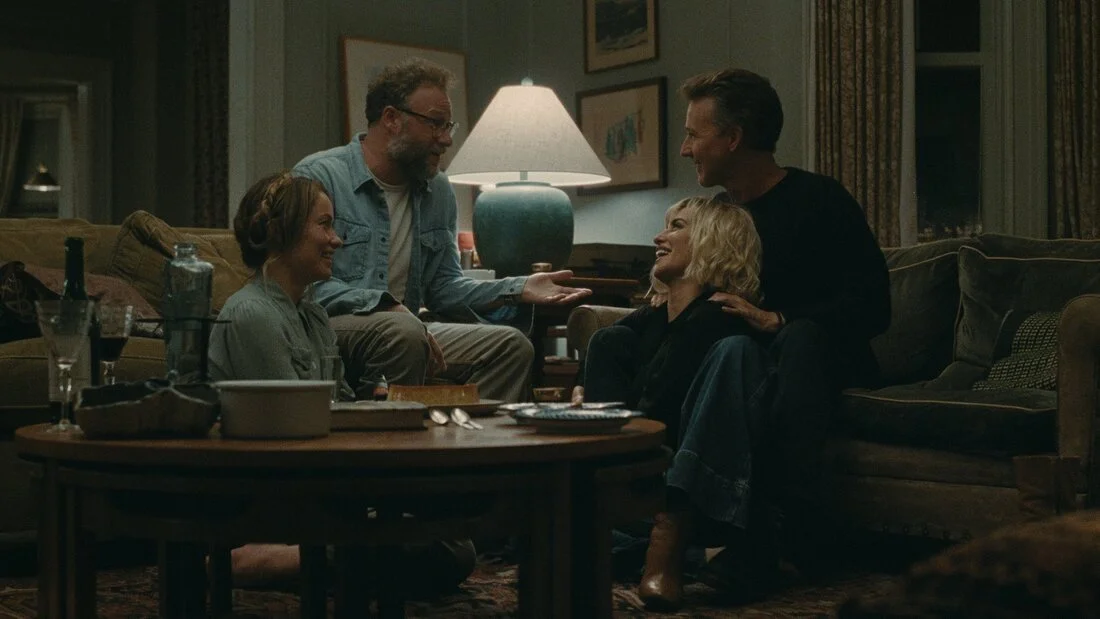
Unbeknownst to Joe, Angela invites Piña and Hawk over for an impromptu dinner party. There’s plenty of charcuterie and barely any wine to gloss over the palpable tension in the room. As the group gets to know one another, Angela and Joe are introduced to a completely different way of being in a relationship. Piña and Hawk seem so intertwined. The sheer newness of their vibe is absolutely intoxicating, and Angela feels insecure. She locks into host mode. Not wanting to cause any waves, she goes with the flow. She works to satisfy her guests on every level, from food and home decor (buying a new rug specifically for this dinner) to everyday pleasantries. Sacrificing one’s own desires for another’s pleasure is deeply recognizable in Angela’s character. The film traces her self-sacrifice to a marriage on thin ice, wherein she has become invisible not just to Joe, but to herself.
There’s a beautiful intentionality to how Wilde visualizes this story. She knows how to frame a room in a way that is emotionally expansive for the characters’ perspectives. Angela, yearning to be seen, is surrounded by glass barriers and reflections. One window in particular becomes part of the narrative fabric; the simple act of Angela walking past it sparks a revelatory plot point and moves the story forward. The film makes excellent use of space, which gives Angela and Joe’s desirable San Francisco apartment a never-ending labyrinth vibe. The apartment also serves as a revealing part of Angela, who compromised her artist dreams to be a stay-at-home mom. Full of vintage pieces and market finds, the space has a personal touch. Production designer Jade Healy (The Green Knight; Marriage Story) makes a point not to create an overly designed setting. Each and every room feels carefully curated to reflect Angela’s life — she poured so much of herself into the overall place, and yet, the bedroom has a minimal design to accentuate how little she and Joe have sex.
While set in one location, The Invite is a wondrously expansive film. There’s no limit to where the characters can go. We feel a distinctive shift in energy and pace as they move from one room to the next. A sensational score from Blood Orange’s Devonté Hynes (Queen & Slim; Passing) accentuates tension and mirrors the film’s buildup of emotional release. Between the look and feel of this film, Wilde knows precisely how to read the room, allowing us to sit in moments of honest tension and awkwardness until they feel vulnerable. She presents an engaging disposition between two polar opposite couples: Piña and Hawk have learned how to communicate sexually, act on their desires, and confidently go after what they want out of life. Angela and Joe have forgotten how to do all of those things.
The idea of polyamory is a major turn on for Angela and Joe, almost blasphemously so, considering they are stuck in a dialogue of sarcasm and defeat. They carry shame around valuing sexual pleasure, and their guests clock the hesitancy from a mile away. Penélope Cruz has a brilliant scene in which Piña naturally assumes the psychotherapist role and cracks open a tense marriage. She gets to the bitter heart of why Angela and Joe are having problems; just by listening to how the two talk to each other, it’s clear how much they blame each other for their own unhappiness. Cruz plays Piña as bold, sensual, and effortlessly cool. She guides conversations with confidence and almost floats from room to room, picking up on idiosyncrasies with great clarity. Cruz has a dynamic partner in Edward Norton, who can take an “everyman” character and subtly transform him into someone enigmatic. There’s more to Hawk’s presence than he initially lets on. Norton builds onto that mystery until he reaches a stunning moment of poignancy, when we learn the history behind Hawk’s name. Norton delivers an excellent monologue about what his character has learned from Piña, and how reaching rock bottom ignited a fire to reinvent himself.
Hawk is in many ways the antithesis to Joe, a former musician who has accepted a life of unhappiness out of fear and comfort. On the surface, he checks the boxes of what many would consider successful. He has a family, teaches music, and lives comfortably in one of the most expensive cities in the world. The apartment, which Joe inherited from his parents, reflects his middle-aged stagnation. We don’t get a sense of his personality or progress in the decor, certainly not in the bedroom. His love of music is revealed in glimpses, including that of a piano he hasn’t played in a while. Rogen brings his signature self-deprecating humour to the role, while also reminding us that he can knock an emotionally layered performance out of the park. His unparalleled comedic timing balances out the moments of deep frustration, wherein it’s clear that Joe is struggling to reignite the spark that once helped define his relationship with Angela. The film uses musically driven moments, such as a pitch perfect Sade needle drop (By My Side, one of the sexiest songs of all time) to highlight parts of Joe’s lively personality that had since become dormant.
In addition to assembling one of the year’s best ensembles, Olivia Wilde delivers a career-best performance that pays homage to the late Diane Keaton. Wilde (who played Keaton’s daughter in Love The Coopers) dedicated The Invite to Keaton, whose sensibilities can be found in Wilde’s own performance as Angela. While in the messiness of despair, Angela is incredibly animated and joyful. She’s alive and inspired. She has suppressed her creativity and sacrificed her desires, but has not lost her craving for genuine connection and sexual satisfaction. There is more to the surface of what we initially see in Angela, and Wilde plays her with wondrous control of each layer. She brings immense curiosity to finding the spark that Angela once felt, so that she can reconnect with her sense of self. Wilde also shines through physical comedy. There’s a clever bit about Angela making a soufflé, putting in a lot of work only to abandon her creation entirely. It’s a visual gag that connects poignantly to the film’s recurring theme of self-sacrifice in relationships.
Angela’s craving for genuine connection and sexual satisfaction dovetails towards a bittersweet ending. For a fleeting moment, she reconnects with Joe, who has found his way back to his piano. They share a harmonious melody together. It might be unclear whether this means the couple will give their marriage another go, or officially break up and start anew (this critic confidently sides with the latter). Wilde sits with the emotional confrontation and lets us ponder a new life for Angela, making it easy to recognize one’s self in the character’s journey. The Invite is a dazzling sex comedy that taps into our relationship desires and reveals the significance of nourishing our inner selves, first and foremost.
